OHL Books · English
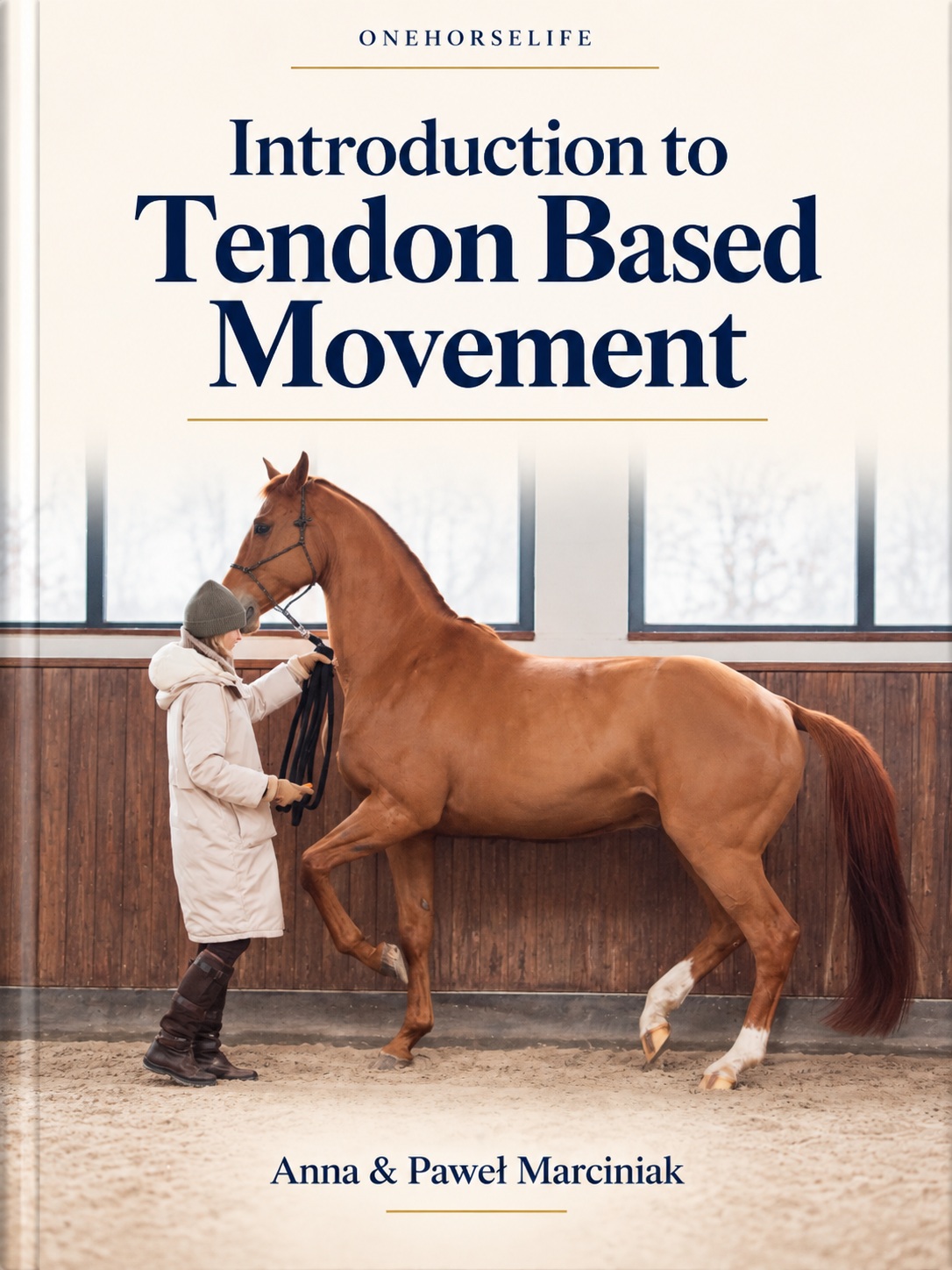
Introduction to Tendon Based Movement
Stop guessing. Understand what really moves your horse.
You can spend years riding, repeating exercises and asking for more effort without understanding why your horse still feels heavy, tense or restricted. This revolutionary book gives you the missing foundation. Discover Tendon Based Movement: how the horse stores and releases elastic energy, what blocks that power, and why relaxation changes the movement itself. Across 23 chapters, you will understand what to look for, what needs to change, and how your own riding affects every stride. Read this book before you ask your horse to work harder.
Included in your OHL Books subscription
Opening chapters are free with an account. One subscription unlocks the OHL Books collection. Books are included in membership, not sold separately. See membership details below.
Who this book is for
Every rider, trainer and horse owner needs to understand the movement they ask a horse to produce. Whether you ride for pleasure or performance, this book gives you a reason behind your decisions. If you want lightness, power and a freely moving back, start here.
01 · What you will learn
Discover the horse’s elastic engine. Understand how the pelvis, long back and relaxed neck work together to store energy and return it through the stride.
See beyond the outline. Recognise a waving back, a neck that moves with it, and the difference between a powerful-looking canter and the correct sequence.
Understand why relaxation creates more powerful movement. See how releasing residual tensions frees pelvic rotation, grows body awareness and changes what the horse can do.
Know what your riding must change. Understand how your seat and hands can block the horse’s back, and why Anna’s Riding Method begins with moving with him.
From the book
An exercise gives him a task without necessarily teaching that connection. A horse can cross every pole while holding his back and shortening his neck. He has solved the problem of getting his feet over the poles through the pattern he already knows. Repeating the exercise gives him more practice in that solution. We need to watch how he completes the task and teach the missing coordination, rather than assume the equipment will produce it for us.Inside the book
- 01Movement and Biomechanics →Free
- 02The Real Biomechanics of Movement →Free
- 03The Birth of Tendon-Based Movement →Free
- 04Our Discovery Story →Subscription
- 05The Myth of the Active Muscle Engine →Subscription
- 06The Timing Problem →Subscription
- 07When Effort Replaces Efficiency →Subscription
- 08The Health Cost →Subscription
- 09From Force to Flow →Subscription
- 10The Hidden Engine Under the Back →Subscription
- 11Observing the Living Wave →Subscription
- 12Every Stride Begins in the Pelvis →Subscription
- 13The Three-Dimensional Spine →Subscription
- 14The Axial Ligament Chain in Detail →Subscription
- 15The Pelvic Bowl and Its Joints →Subscription
- 16The Connection to the Limbs →Subscription
- 17The Nuchal–Supraspinous Connection →Subscription
- 18The Head and Neck as a Counterweight →Subscription
- 19Using the Spring Is Not Enough →Subscription
- 20What Relaxation Really Means →Subscription
- 21Learning a Different Way to Move →Subscription
- 22More Energy Through Relaxation →Subscription
- 23The Rider Becomes Part of the Movement →Subscription
Questions about the book
Why should I read this book before doing more training?
Because an exercise does not tell you how your horse is completing it. He can cross poles, hold an outline and repeat a gait while preserving the same restrictions. This book gives you the foundation to recognise what is happening through his body and understand what needs to change. Your next training decision should come from understanding the movement you see.
Is this book for me if I am new to Tendon Based Movement?
Yes. This is where you begin. Clear examples, from snapping your fingers to jumping on a trampoline, make the elastic mechanism understandable. You will follow the connection from the pelvis through the back to the neck, then understand conscious relaxation, learning new movement patterns and the rider’s role. You do not need to have studied Tendon Based Movement before.
Does relaxation mean a slower, less powerful horse?
No. Residual tensions restrict the rotation of the pelvis and the loading of the long ligaments along the spine. Releasing that holding lets the horse store and return energy more effectively. You will understand how relaxation produces a fuller, more expressive stride, and how to distinguish that power from rushing. Relaxation belongs inside energetic movement.
OHL Books
Get library access
Included in your OHL Books subscription
OHL Books Membership
One subscription. The whole published library.
- Access to every published book and chapter.
- Newly published books are included while your subscription is active.
$5 for the first 3 days
Then $18 per month
VAT and other applicable taxes are excluded.
Renews monthly after the trial. Cancel anytime in your profile.
Sign in
Sign in by email
We will email you a six-digit challenge code. No password required.
By logging in or creating an account, you agree to the Terms and conditions and acknowledge the Privacy Policy. This does not provide consent to optional tracking or marketing.